astro-doctor
 JavaScript
 Node.jsWASM
 Astro
Deterministic static analysis for Astro — 42 rules across islands, hydration, SSR, security, and performance. No LLM, no network; every finding ships file, line, and fix recipe.
Your agent writes bad Astro. astro-doctor catches it.
astro-doctor deterministically scans an Astro codebase for issues across islands and hydration, data-fetching and prerendering, performance, security, correctness, and maintainability. It exists for the exact failure mode AI coding agents produce: confident, plausible Astro that silently misuses client:* directives, leaks server-only code to the browser, or breaks under ClientRouter navigation. No LLM judging, no network calls — 42 AST/regex rules, each emitting file, line, and a fix recipe.
It runs three ways: a CLI (astro-doctor [dir], with --json for machines, --fast and --cache for iteration), a programmatic API (scanDir), and a CI gate (astro-doctor ci install writes the GitHub Actions workflow; exit code 1 on any error). A doctor.config.mjs tunes severities and ignore globs, and findings suppress explicitly with reasoned comments — no allowlists. It also ships an agent skill (skills/astro-doctor/SKILL.md) so Claude Code, Cursor, Codex, or OpenCode can run it, read the JSON, and apply fixes in a loop.
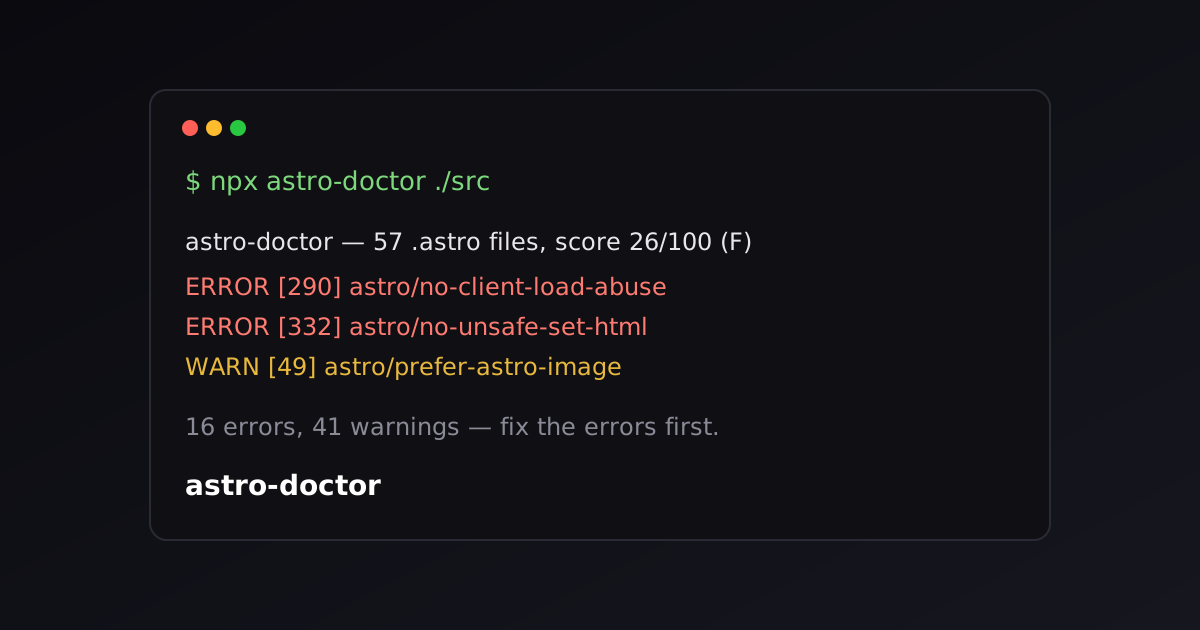
Under the hood, template structure comes from a compiler-backed Document IR (@astrojs/compiler, with a quote-aware scanner fallback), frontmatter JavaScript goes through a single-pass lexer, and correctness is enforced structurally: length-preservation invariants, a 200-mutant fuzz run over every rule, CLI exit-code and JSON-shape tests, and compiler/scanner agreement plus metamorphic property suites. On my own portfolio it went from 16 errors and 41 warnings to a clean 100/100 — and along the way caught two production 404s (a default social image and a manifest icon that didn’t exist).
The cover above reproduces its actual first run on this site: 16 errors, 41 warnings, score 26/100.