
my thoughts on the current state of personal assistants.
hi so i’m the founder of the experience company and we’re building a personal assistant called gaia.
 the experience company
 gaia
gaiai’ve been working on this for some time now when it started out as a project in college which i eventually ended up wanting to turn into a startup.
my belief system started with the vision that i wanted to build an assistant that everyone in the world could use.
at the time we didn’t really understand the scope of what that meant, or how things would go. but over time we’ve learned so much and gained a lot of insight into what that might actually mean for us in the foreseeable future. it has taken a lot of iteration on the product direction and refinement of the vision to get us to where we are today. we’re still not there yet.
a lot of people are building assistants
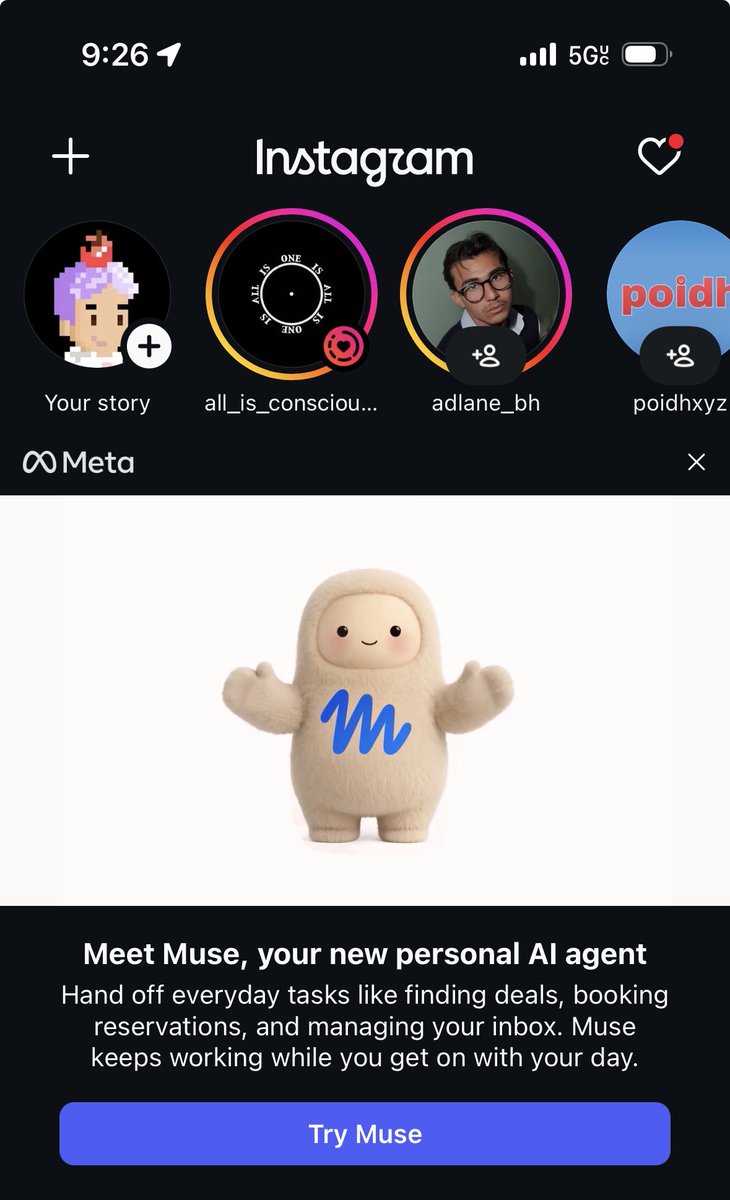
meta has just come out with their assistant called muse, instinct just came out as a viral assistant, xai (twitter) came out with grok bot, a couple months ago poke was the hot assistant in the game before getting acquired by devin. there’s so so many more in the long list of recently launched personal assistants with pretty much the same core idea. we belong to this group of assistants with a similar core product.
on a side note, i feel like we have it insanely more difficult than most compared to these vc funded startups, considering that we’re not from a traditionally shiny background, nor have good mentorship or a support system. we’re literally in this blind tbh with the world against us. but i’m fine with it. i’m going to do what i love. i have a vision and conviction and i’m not gonna wallow in self pity.
it is going to be really difficult to differentiate and establish footing in a world where every large tech company will be trying to solve and capitalise on the same problem that everybody feels like they have.

some people are looking at this and saying retention < distribution, but that’s a shallow lens. look a layer deeper and see how many other meta products flopped before even with the same distribution surface area held constant. metaverse? poke? meta ai? zuck bet his soul on VR before, how’d that turn out? meta expands their distribution if the product retains and i don’t need to look at the numbers. @muse is a great product that retains. yelling distribution is king is a fool’s game. doesn’t matter how many phone farms you run, you can’t beat 1/1000000 of meta’s reach. retention wins when you are small, it keeps winning harder as you get big. it’s just insanely hard to achieve even for meta.
why this is so hard
there’s a ton of issues and unanswered questions yet to figure out in this space that are just non-trivial.
i feel like building a company like this isn’t as simple as a very specific hyper niche use-case like “building ai for lawyers” (a crude example perhaps), that’s why it’s even harder to get it right.
it’s fundamentally just a broad idea with a large array of problems to solve that need to be gotten right for the first time.
the gap is massive
the gap between the current state of ai and what the world knows and uses is fucking massive. most of the world still thinks of ai as just chatgpt, you enter something and it spits some words out. whereas the reality is quite different. people just don’t realise the state of llms and the scope of what’s actually possible in reality.
even for the people who do use ai, most use-cases and verticals are just unexplored tbh. like if you’ve seen anthropic’s chart (attached below) the observed ai usage is shocking.
2 things. retention, and market.
1. retention
this is notoriously one of the hardest things to figure out for any consumer software product. even more so with ai agents considering this is just a completely new surface area of how products work and how most consumers interact with such technology.
2. market
the market is just extremely early while the technology is way too ahead. eventually the market will catch up tho. we are too early for our time and so are most companies in this space imo. if someone says meta has all the distribution to market an ai assistant i just disagree. they had all the distribution for the vr space too, what happened there? they were too early. nobody was ready yet for it. nobody understood it yet. the same applies for ai.

it’s not just about industries either, like software development is the most popular industry where ai is used. but in the average world outside of twitter or outside sf or the valley, people still don’t use ai the way the top 1% do. hell i barely even saw people using claude code. the company i used to work at was fairly ai forward but shared a single max plan between like 20 people and my co-founder’s and my individual usage was more than the rest of the entire company’s usage combined. i’ve seen people still using and advocating for github copilot or copy-pasting code or being LLM averse when the frontier is light years ahead. it’s apparent that the distance between the top 1% and the rest will take a long time to bridge the gap just because it’s just progressing too fast for most to keep playing catch up.
most people aren’t technical
i also think getting ai right for most people is quite difficult considering the average normie isn’t very technical.
there’s a reason why openclaw failed after a few months of hype. first off, too technical for most people to setup. this is partly why hermes agent took off. and then the people who did end up setting it up, barely found any use-cases for it. like sure it’s cool but what can i do with it is the consensus i’ve found to be on twitter a few months after the hype died.
it’s very difficult for the average consumer to just grasp the scope of capabilities of any agent in general while having a healthy balance of simplicity in order to not overwhelm the user. needs to be a healthy balance.
nobody pays, nobody stays
another thing is that everyone just wants everything for free right now. this is great for gathering usage data but not at all great to understand if users actually want your product, will you actually make money off it, and if they’ll even come back to it. these are critical questions to be asked in an age where companies have virtually infinite money.
additionally, we can see that none of these power users really have any loyalty to a product or any model. you can see this with the model usage stats of opencode. purple is when deepseek v4 flash was free. blue was when glm 5.3 flash was in stealth as ox-alpha and had unlimited free usage. pink is muse spark 1.3 contributor another free model.

this is just proof to show that these models go trending when free because i’ve seen developers don’t care about their data being sold ngl, and personally i don’t mind my coding data being sold for the betterment of models either. this is a completely different story for non tech consumers who do pretty much care about privacy and would be wary about even connecting shit like emails. it’s gonna be difficult for people to trust meta for an assistant that manages their entire life. even more so for a closed-source one.
models aside, people switch harnesses too so quickly just to try it out for the fun of it. people switching from openclaw to hermes, trying out different stuff like cmux, conductor, herdr, opencode, kiro, commandcode so so so many more i’ve lost count.
what even is the moat anymore?
the question arises, what really is the moat anymore?
building an ai assistant i could argue that perhaps memory is the moat? maybe if your memory exists in 1 place, it’ll be too tough to switch? meh. although nowadays i’m just skeptical if a moat really even matters any more? i’m really not sure. what moat does lovable or cursor have over companies like github who virtually had all the coding data in the world, they had first mover advantage, they owned fucking vscode, they are literally microsoft? and still lost? even so, what moat do they have over other coding companies? what moat does fucking perplexity have over google???? they don’t really, and still everybody’s making money building coding agents ngl. i understand david vs goliath and the fact that incumbents do survive and beat giants. but the question of do you still need one, or can you even have one, in the age of ai? still exists.
ux is the whole game
i have conviction that user experience is going to be one of the most critical yet difficult parts of getting an assistant to a billion users. it’s different than the gpt moment for example, because the wow moment for a chatbot is just the textual response, an ai agent is far more complex and difficult to understand the scope of how good it is.
it’s gonna be really difficult to build the assistant that “just works” for you but it’s something we really do believe we are going to do.
like just imagine how seamless it would be if you just had no friction whatsoever you just signup and boom your life is just multiples better and more productive than before. wouldn’t that be great?
terrified of what’s next
to be completely honest with you i’m really terrified of where the future lies ahead. of course because of “super intelligence” but also along with the fact that we’re in such a saturated market. not saturated in terms of everyone already having an assistant and how to convince them to switch, but mostly the fact that it’s saturated in terms of the amount of people building assistants in the same breath as us is growing larger by the day, while the reality of usage by consumers is quite far behind.
also, we just really don’t know what the future is going to look like. there’s so many conflicting opinions and ideas as to what the ux is gonna be like.
- mcp vs cli?
- native integrations vs browser use
- browser use vs computer use
- cloud vs local
- imessage/whatsapp vs threads (like xai bot)
- tui vs gui (even for coding agents)
some can say it’s about preference but i disagree. it’s not just about what you like and use as your daily driver, the world will eventually ideally converge into common best practices in terms of what works best seamlessly based on usage habits. we just don’t know what that will look like for a non power user.
intelligence is getting cheap
i do think and know that the models are gonna get cheaper tho. we’ve seen in just the past 6 months that open-source models have gotten so damn good they can now compete with the frontier at a fraction of the cost. this will and is forcing the frontier labs like openai and anthropic to reduce their prices, if not now, then eventually. this is gonna lead to a paradigm shift where it’s just gonna be a race to the bottom as to who can serve these models the cheapest ngl. then when they get to a level where inference is free, it’s gonna be companies like cerebras who pose the question who can churn out tokens the fastest. and ngl the last mover advantage that companies like apple are gonna be betting on will win. starting a frontier llm lab sounds good until you’re just burning vc money for years until a lab who just started comes out with a model better than yours.
this is where the consumer wins tho. when intelligence gets close to free, “always on” intelligence gets closer to reality.
i remember we started with models like gpt 4o mini, because it was the only model we could afford, but then we realised it wasn’t good enough, we used stuff like llama 3 70b which was really good at the time but still not great for tool calling (also really weirdly inconsistent behaviour), we used grok 4.1 code fast which oh my god was surprisingly good for how much it cost, it also even spoke really nicely based on our prompt like really enjoyable for us to use, but still slightly struggled with tool calling, we settled on gemini 3.1 flash lite bcz we had a ton of gcp startup credits to use, but the issue there too was it was great and cheap, but not great enough. we tried a bunch of other models like minimax m3, glm 5.3 which was really the perfect model for our use case but unfortunately was really costly and a bit slow to use for the experience we were trying to serve. then deepseek v4 flash 0731 came out and it was perfect. cheap, fast, and reliable enough to not face any major issues. fucking finally. and it was supposedly really good on benchmarks too. we could finally serve customers without a disappointing experience and without breaking the bank!
this was a major product problem and an issue for us i can’t lie. because we were broke, we were unable to serve good models, and so nobody would pay because the shitty models didn’t work properly. so it was like a chicken and egg problem. which came first? the money or the good product?
but now, times have changed i guess.
retention
retention will become ever more important now. the assistant that is so addictive to use that it becomes painful to leave is a challenging issue to solve but it’s apparent that this will differentiate the winners from the rest. the “claude code” moment for agents is awaiting.
getting someone to try a product and making it a critical part of their lives and workflows seamlessly are 2 completely different things imo.
inspiring companies
sometimes it gets a bit low to think of the state of feeling so much behind than the competition in such a partially saturated market. i find solace in a couple of inspiring companies who were in the same situation as us: (references from GPT)
-
zoom: went up against cisco, skype, google, gotomeeting, etc. their thing was basically: video calls should just work.
-
spotify: went up against apple, google, amazon, youtube, piracy, etc. they made listening to music stupidly easy and became the default place people went.
-
notion: went up against google, microsoft, evernote, dropbox, slack, etc. they made one flexible workspace that people could actually build their shit in, and shared pages naturally pulled other people in.
-
superhuman: entered email against gmail and outlook, with basically zero chance of beating google/microsoft on distribution. they didn’t try. they made email ridiculously fast for a narrow group of power users, charged a lot, and built a cult around the product.
-
arc: entered browsers against chrome, safari, firefox, edge. basically the worst possible competitive setup. they didn’t have google’s distribution or apple’s hardware ecosystem. they made the browser itself feel fundamentally different and attracted a fanatical early user base.
-
linear: entered project management against jira, asana, trello, monday, clickup, etc. those companies had vastly more users and money. linear didn’t win by having more features. it made a very specific group of people say “holy shit, this is so much nicer.”
 zoom
zoom spotify
 notion
 superhuman
 arc
arc linear
perhaps winning still might be possible after all. :) time will tell.
btw i’m going to be moving to sf soon. so if you’re reading this and wanna meet up and have a chat feel free to get in touch with me.
also, go sign up: heygaia.io and email me if you have feedback!